

Banner Stands Explained: The Complete Guide to Roll Up, Retractable, Freestanding & Tension Displays
If you’ve ever searched for a roll up banner, pull up banner, roller banner, retractable banner or exhibition banner stand, you may have wondered what the difference actually is.
The answer is surprisingly simple.
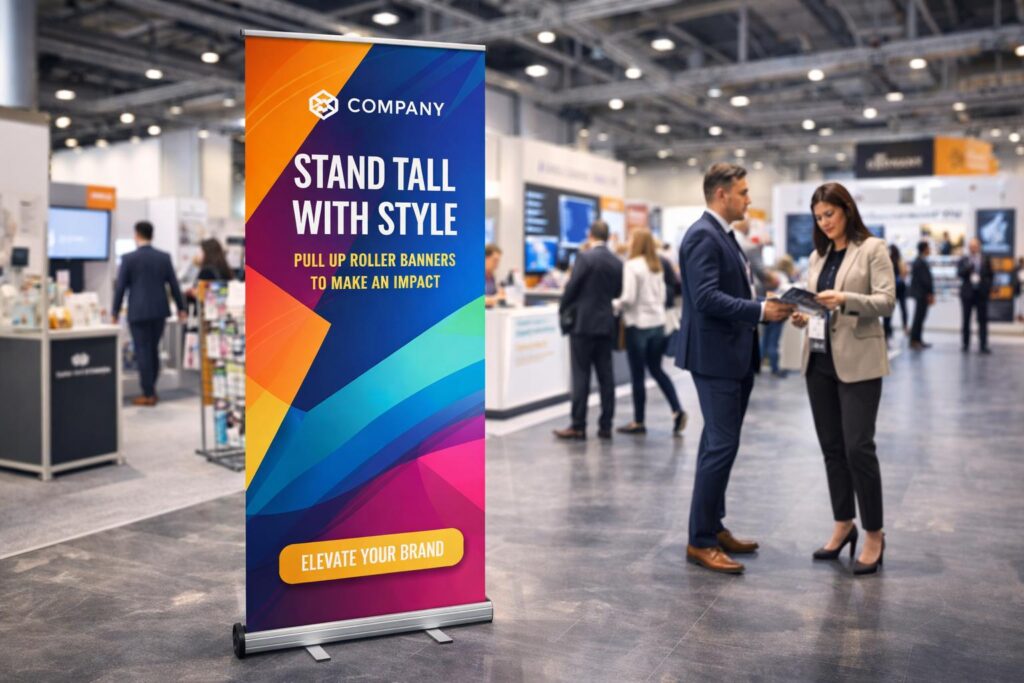
In many cases, roll up, pull up, roller and retractable banners are different names for essentially the same style of display. They all use a retractable printed graphic that rolls into a cassette or base for storage and transportation.
But that’s only the beginning.
Today’s banner stand market includes wide roller banners, double-sided systems, freestanding displays, tension fabric banners, curved backdrops, outdoor banner stands and large-format exhibition systems.
With so many choices available, selecting the right display can be confusing.
This guide explains the different styles, what they are best used for and, perhaps most importantly, what you should look for in the printed graphic itself.
Roll Up, Pull Up, Roller or Retractable Banner – Are They the Same?

Let’s start with the most popular banner stand of all.
You may see it advertised as a:
- Roll up banner
- Pull up banner
- Roller banner
- Retractable banner
- Retractable roller banner
- Pull-up display
- Roll-up display
For the most part, these terms describe the same basic principle.
A printed graphic is attached to a spring-loaded cassette at the bottom of the display. When you need the banner, you pull the graphic upwards and secure it to a supporting pole.
When the event is finished, the graphic retracts back into the cassette.
It’s simple, compact and remarkably effective.
This is why roller banners remain one of the most popular forms of portable advertising in the UK.
They can be used at exhibitions, conferences, reception areas, retail promotions, shopping centres, universities, hotels, sporting events, product launches and corporate presentations.
For many businesses, a roll up banner is the first exhibition display they purchase.
And for good reason.
For more information on market stalls read our guide on A Comprehensive Guide to Exhibition Banner Stands for Maximum Impact: Elevate Your Brand with Stand Banner.
Why Roll Up Banners Remain So Popular
The biggest advantage of a retractable banner is convenience.
There are no complicated frames to assemble and no specialist installation team required.
The graphic is already stored inside the cassette.
Simply position the base, attach the pole and pull the graphic upwards.
Within minutes, you have a professional branded display.
They are also remarkably portable.
Most systems can be transported in a carry case and stored in a vehicle, office or storeroom between events.
For businesses attending multiple exhibitions during the year, this portability can make a significant difference.
But there is another important advantage.
The hardware can often be reused.
If your marketing campaign changes, you may only need a replacement graphic rather than an entirely new banner stand.
This can make a quality retractable banner a considerably better long-term investment than repeatedly purchasing inexpensive disposable displays.
Wide Roller Banner Stands

Sometimes a standard roll up banner simply isn’t big enough.
That’s where wide roller banners come into their own.
Instead of creating a narrow vertical display, a wider cassette provides significantly more graphic area.
This gives designers more room to work with.
Large photographs can be used without being heavily cropped. Headlines can be larger. Product ranges can be displayed more effectively and logos can be given greater prominence.
Wide roller banners are particularly useful when you want the visual impact of a larger backdrop without moving to a full exhibition stand.
They can also be positioned alongside counters, other banner stands or exhibition backdrops to create a larger branded environment.
Double-Sided Roller Banners

A double-sided roller banner is designed to communicate in two directions.
Rather than having one graphic facing one audience, the system carries graphics on both sides.
This can be extremely useful in busy exhibition halls where visitors may approach from either direction.
Imagine your stand positioned beside a main walkway.
A conventional single-sided banner might only communicate with people walking towards it.
A double-sided banner can communicate with visitors approaching from both directions.
It can also be useful where two different messages need to be displayed.
For example:
Side one: Brand and company information.
Side two: Product launch or promotional campaign.
This effectively gives you two advertising surfaces from one compact floor-standing display.
Freestanding Banner Displays

Freestanding banners are different from traditional retractable systems.
Instead of the graphic disappearing into a cassette, the printed image is mounted onto a separate frame or support structure.
This opens up considerably more possibilities.
Freestanding systems can be produced in larger formats and can accommodate different graphic shapes and configurations.
They are particularly useful for exhibition back walls, retail displays, corporate environments, museums, visitor attractions and large promotional spaces.
They can also provide a more architectural appearance than a traditional roller banner.
If you want your display to become part of the environment rather than simply an individual advertising banner, freestanding systems are worth considering.
Tension Fabric Banners

Tension fabric displays have become increasingly popular in modern exhibition design.
Instead of printing onto a rigid board or retractable banner material, the artwork is printed onto specialist stretch fabric.
The fabric is then stretched tightly over a lightweight frame.
The result is a smooth, almost seamless graphic surface.
This creates a completely different aesthetic from a traditional roller banner.
Tension fabric is particularly effective for:
- Exhibition backdrops
- Conference displays
- Media walls
- Product launches
- Corporate events
- Retail environments
- Press conferences
- Hospitality displays
The fabric can also be removed from the frame, folded and transported, making the system practical for businesses that exhibit regularly.
Straight or Curved – Which Exhibition Banner Looks Best?

The shape of an exhibition display can dramatically change how it looks.
A straight banner gives a clean, traditional appearance and makes excellent use of a flat wall or stand area.
A curved display introduces movement and can create a more distinctive presence within an exhibition hall.
Curved systems are particularly effective where you want the display to stand out from neighbouring exhibition stands.
Neither is necessarily better.
It’s about the environment, the available floor space and the visual effect you want to create.
Outdoor Banner Stands Are Different

An indoor exhibition hall is a controlled environment.
Outside is very different.
Wind, rain, uneven surfaces and changing weather conditions all need to be considered when selecting an outdoor banner system.
Outdoor displays may use weighted bases, water-filled bases, ground stakes or other stabilisation systems.
They’re commonly used for festivals, sporting events, retail promotions, forecourts, agricultural shows, roadshows and outdoor exhibitions.
One important point is often overlooked:
A standard indoor roller banner should not automatically be assumed to be suitable for outdoor use.
If you’re planning an outdoor event, choose a system specifically designed for the conditions.
The Most Important Part of a Banner Is Often the Graphic
It’s easy to concentrate on the hardware when purchasing a banner stand.
But the hardware is only the framework.
The graphic is what your customer actually sees.
A premium banner stand with poor-quality printing can look considerably worse than a well-designed banner mounted onto a simple but reliable system.
This is why print quality matters.
High-resolution printing produces sharper images, cleaner small text and more precise detail.
For photographic artwork, resolution becomes particularly important.
A photograph that looks excellent on a computer screen may not necessarily look excellent when enlarged to exhibition size.
Professional large-format printing therefore requires careful attention to the original artwork, image resolution, colour profiles, scaling and the chosen print media.
A good printer should be able to advise whether your artwork is suitable before production.
What Does 1200dpi Printing Actually Mean?
The term 1200dpi is frequently used when discussing premium exhibition printing.
DPI means dots per inch and describes the resolution capability of the printing process.
Higher-resolution printing can produce exceptionally fine detail, helping text, logos and photographic imagery appear crisp and professional.
However, it’s important not to assume that simply specifying a high DPI automatically makes every banner better.
The final result depends on much more than the printer’s headline resolution.
It also depends on:
- The quality of the artwork.
- The original image resolution.
- Colour management.
- Ink technology.
- Printing technology.
- The banner substrate.
- Viewing distance.
- Finishing quality.
- How the graphic is manufactured and installed.
This is where experienced large-format printers can make a genuine difference.
B1 Fire Rating – Why Does It Matter?
If you’re exhibiting at a professional venue, fire rating should never be an afterthought.
Many exhibition centres, conference venues and event organisers have specific requirements regarding the fire performance of display materials. Note: Many print companies folsify B1 fire rating as many use solvent based inks, that are not b1 fire rated and that can be easily identitified by smell. This may result in cancelled entry or removal from the venue. Why not read our blog on the importance of B1 fire rated exhibition graphics.
B1 is a commonly referenced fire classification for materials used in exhibition and display environments.
Choosing appropriately fire-rated graphics can help ensure your display complies with the requirements of the venue or event organiser.
However, requirements vary.
The safest approach is always to check the event’s exhibitor manual or speak to the venue before ordering.
For professional exhibitors, selecting the correct fire-rated substrate can prevent an unpleasant surprise during stand inspection or installation.
It is particularly important when you’re investing in a complete exhibition display that may include banners, backdrops, counters and other printed graphics.
Anti-Glare Printing – A Small Detail That Makes a Big Difference
Exhibition halls are full of artificial lighting.
Spotlights, overhead lighting and LED systems can create reflections across glossy printed graphics.
That reflection can make your carefully designed message difficult to read.
Anti-glare materials and finishes help reduce unwanted reflections, making the graphic easier to view from different angles.
This becomes particularly important when the banner contains:
- Small text.
- Detailed photography.
- Product information.
- QR codes.
- Charts.
- Technical information.
- Logos.
A banner may look fantastic when photographed in the printing studio but perform differently under the bright lighting of an exhibition hall.
Understanding the environment in which the display will be used is therefore an important part of choosing the correct print material.
Anti-Curl and Scratch Resistance
A banner stand needs to look good not just on day one, but after being transported between events.
Repeated rolling, packing, unpacking and storage can put stress on printed graphics.
Anti-curl materials help the graphic maintain a clean, professional appearance.
Scratch resistance is also important.
The graphic can be handled when being installed, removed, packed and transported.
A more durable print surface helps minimise the risk of marks and damage.
For businesses exhibiting regularly, these details can make a substantial difference to the lifespan of the display.
Environmental Materials and Inks
Environmental responsibility is becoming increasingly important in exhibition and display printing.
Businesses are looking beyond simply asking whether something can be recycled.
They’re considering the entire lifecycle of the display.
Can the hardware be reused?
Can the graphic be replaced without replacing the frame?
Can PVC-free materials be used?
Are more environmentally responsible inks available?
Can the display be transported efficiently?
Can the graphic be recycled at the end of its useful life?
These are all worthwhile questions.
Where appropriate, choosing reusable hardware and replaceable graphics can help reduce unnecessary waste.
Modern printing technologies can also provide lower-impact ink and substrate options for certain applications.
The correct environmental choice will depend on the intended use, required durability, venue requirements and budget.
Reliability, Warranty and Why Cheap Isn’t Always Cheap
A banner stand is often purchased because it needs to work repeatedly.
That means reliability matters.
A cassette that doesn’t retract correctly, a pole that becomes loose or a base that isn’t stable can quickly turn a cheap purchase into an expensive problem.
This is why it is worth considering the manufacturer’s reputation, warranty and after-sales support.
A reliable banner system should be designed to withstand regular assembly, transportation and storage.
For businesses attending multiple exhibitions every year, a quality system can prove considerably more economical over its lifetime.
The ability to purchase replacement graphics is another important consideration.
Your business may change its branding, launch a new product or run a different campaign.
Being able to replace the printed graphic while continuing to use the hardware can significantly extend the useful life of the display.
Stand Banner – Over 35 Years of Exhibition Display Experience
When it comes to choosing a banner supplier, experience matters.
Stand Banner has over 35 years of experience in the exhibition and display industry, supplying banner stands, exhibition systems and large-format printed graphics to businesses throughout the UK.
Rather than being restricted to one manufacturer or one style of display, Stand Banner offers an extensive range of banner systems from leading manufacturers.
These include established names such as Plex Display, Easystands and Ultima Display, alongside many other professional display systems.
This breadth of experience is important because there isn’t one banner stand that is perfect for every customer.
A small business attending two conferences a year may want a lightweight roll up banner.
An exhibition contractor may require a large modular system.
A corporate marketing department might prefer a premium tension fabric backdrop.
A retailer may need a double-sided roller banner.
An outdoor events company could require weather-resistant advertising displays.
The right solution depends on the application.
Stand Banner’s experience across these different systems means customers can choose from a much broader range rather than simply being offered the same product for every requirement.
Which Banner Stand Should You Choose?
| Banner style | Best for | Main advantage |
|---|---|---|
| Roll up / Pull up / Roller | Exhibitions, conferences, retail | Portable and quick to assemble |
| Retractable | Regular promotional use | Graphic stores inside cassette |
| Wide roller | Larger branding | Greater graphic area |
| Double-sided roller | Busy walkways | Branding visible from both directions |
| Freestanding | Large displays | Flexible graphic sizes |
| Tension fabric | Exhibition backdrops | Smooth, contemporary finish |
| Curved tension | Premium exhibitions | Distinctive visual shape |
| Outdoor banner | Festivals and events | Designed for outdoor conditions |
| Pop-out / X / L banner | Short-term promotions | Lightweight and economical |
From a Simple Banner to a Complete Exhibition Display
A banner stand doesn’t have to work alone.
One of the biggest developments in exhibition marketing has been the move towards creating complete branded environments.
A business might use a roll up banner beside a branded promotional counter.
Behind it could be a large tension fabric backdrop.
Product plinths can create additional display space while printed tablecloths reinforce the branding.
Outside the venue, promotional flags or a branded gazebo can continue the visual identity.
The result is a consistent brand experience from the entrance of the event through to the exhibition stand itself.
Final Thoughts
The humble banner stand has come a long way.
What started as a simple retractable advertising display has developed into a huge range of portable exhibition and promotional systems.
Retractable , pull up, roller and roll up banners remain among the most practical choices for businesses that need a portable, reusable display.
Wide and double-sided versions provide greater visibility.
Freestanding systems offer larger and more flexible graphics.
Tension fabric displays provide a modern alternative for exhibition backdrops.
Outdoor systems are designed for events where weather and stability become important considerations.
But whichever system you choose, don’t overlook the printed graphic.
Print resolution, colour reproduction, material quality, anti-glare performance, anti-curl properties, scratch resistance, fire rating and environmental considerations all contribute to the finished result.
And don’t forget reliability.
A banner stand is an investment in your brand. Choosing dependable hardware, quality graphics, an appropriate warranty and a supplier with genuine industry experience can make the difference between a display that lasts for one event and one that continues working for your business for years.
With over 35 years of experience, Stand Banner has built its reputation by supplying a broad range of professional banner and exhibition display systems from leading manufacturers including Plex Display, Easystands and Ultima Display.
Whether you need a simple roll up banner for tomorrow’s meeting or a complete exhibition display for a major trade show, the key is the same:
Choose the right system, use the right materials and make sure your branding looks as good in the exhibition hall as it did on the screen.
For more information on our range of advertising banner stands service please contact us or call Stands Banner on: 0800 246 1352.