

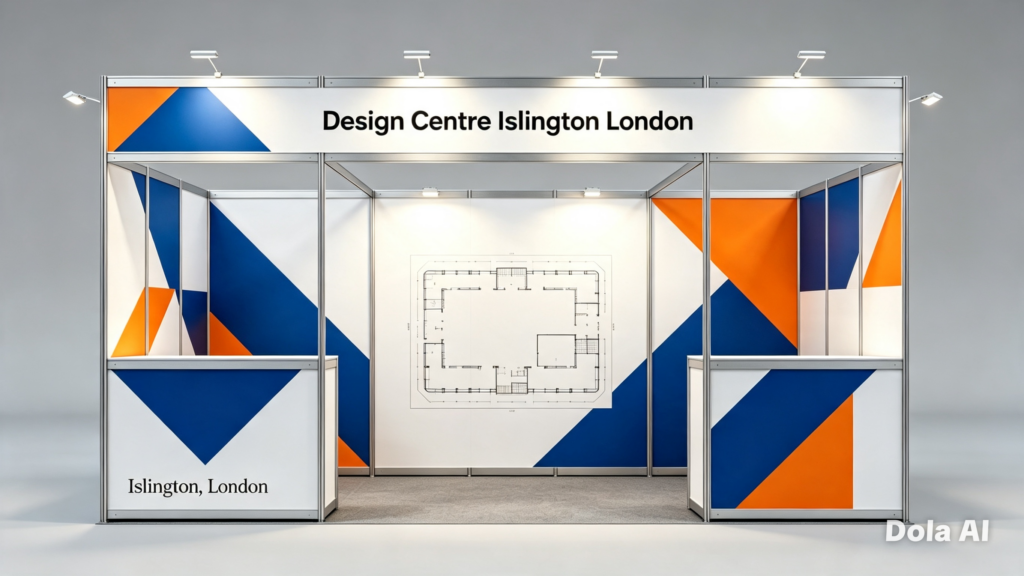
A Question Every Modern Exhibitor Is Asking
Artificial intelligence has changed the way businesses create marketing graphics. In a matter of seconds, tools such as ChatGPT, Perplexity, Google Gemini, and Google AI can generate colourful images, exhibition stand concepts, product mock-ups, social media graphics, and even complete advertising layouts. For a business preparing for a trade show, the appeal is obvious: fast results, little or no design cost, and no need for specialist software.
So the question naturally follows:
Would I use AI for free imaging on an exhibition display?
The short answer is no.
The longer answer is it depends on what you are trying to achieve.
If you need a quick concept, a rough visual, or a temporary marketing graphic and price and time are more important than precision, then yes, AI can be a viable option. But if you are investing in a professional exhibition display that represents your brand in front of customers, buyers, investors, or the public, then the answer is usually no, not yet.
This article explains why.
The Simple Answer: No
When we are producing exhibition graphics for a paying client, especially large-format exhibition displays, shell scheme panels, pop-up stands, fabric backdrops, or retail graphics, we generally would not rely on AI-generated imagery as the primary source artwork.
Why? Because exhibition printing is not the same as creating an image for a website or social media post.
Professional exhibition graphics involve:
- Accurate dimensions
- Print resolution
- Colour management
- Brand consistency
- Material selection
- Fire certification
- Viewing distance
- Lighting conditions
- Finishing requirements
- Installation tolerances
AI tools rarely understand all of these factors.
But Is AI Useful? Absolutely
AI is extremely useful for ideas.
For example, AI can help you:
- Generate stand concepts
- Explore colour schemes
- Visualise exhibition layouts
- Create mood boards
- Produce presentation visuals
- Test marketing messages
- Brainstorm campaign themes
For a start-up with a limited budget, AI can be a valuable creative assistant. It can reduce the time needed to move from a blank page to a workable concept.
The danger comes when businesses assume that a visually attractive AI image is automatically suitable for professional large-format printing.
Does AI Produce High Enough Quality Graphics?
Question
Can AI generate graphics that are good enough for exhibition printing?
Yes, but not always.
Modern AI image generators can produce surprisingly detailed artwork. Some outputs are excellent and may look impressive on screen. However, exhibition graphics are often viewed at close range and printed at large sizes.
A graphic that looks sharp on a laptop may reveal problems when enlarged to:
- 2m x 2m backdrops
- 3m shell scheme walls
- 5m exhibition murals
- Fabric display walls
- Retail window graphics
Common AI issues include:
- Soft edges
- Inconsistent text rendering
- Distorted logos
- Incorrect perspective
- Artificial-looking people
- Unrealistic product details
- Repeating patterns
- Low native resolution
Professional exhibition printing typically requires artwork prepared specifically for large-format output, often at high effective resolution with correct colour profiles.
AI can sometimes meet those requirements, but it cannot be assumed.

Does AI Understand Your Branding?
Question
Does AI understand your brand identity?
Answer
Yes, but not always—probably mainly no.
You can upload a logo, describe your colours, and provide brand guidelines, and AI may produce something that resembles your branding. But true brand understanding goes much deeper.
A professional designer considers:
- Brand heritage
- Market positioning
- Typography hierarchy
- Tone of voice
- Customer expectations
- Existing marketing materials
- Competitor differentiation
- Cultural considerations
AI tends to work from patterns it has learned rather than from a genuine understanding of your business.
A luxury brand, a healthcare company, a government organisation, and a technology start-up may all require very different visual treatments, even if they use similar colours.
Does AI Understand Your Target Audience?
Yes, but not always—again, probably mainly no.
AI can generate images aimed at “young professionals,” “families,” or “business executives,” but real audience targeting requires research, experience, and commercial insight.
An experienced exhibition designer will ask:
- Who will visit the event?
- What industry are they in?
- What motivates them?
- What objections do they have?
- What visual style appeals to them?
- What message should be seen first from 10 metres away?
AI can imitate audience styles, but it does not truly understand visitor behaviour within an exhibition environment.
Exhibition Design Is More Than a Pretty Picture
One of the biggest misconceptions is that exhibition graphics are simply decorative.
In reality, an effective exhibition stand is a communication tool. It must:
- Stop visitors walking past
- Communicate the brand instantly
- Explain the offer quickly
- Direct attention to key products
- Support conversations
- Encourage enquiries
- Photograph well
- Work under exhibition lighting
- Comply with venue regulations
These are strategic design decisions, not just artistic ones.
Print Nuances That AI Usually Misses
This is perhaps the most important issue.
Professional print production involves many technical nuances that AI systems generally do not account for.
Colour Conversion
Most AI images are created in RGB colour space. Exhibition printing is usually produced in CMYK or device-specific print profiles. Colours can shift significantly during conversion.
Black Density
Large black areas may require specific ink builds to avoid banding or muddy tones.
Fabric Stretch
Tension fabric displays stretch slightly when fitted, so critical elements must be positioned carefully.
Panel Alignment
Pop-up stands and shell scheme panels may have joins where artwork needs to align precisely.
Bleed and Trim
Graphics require bleed areas that AI images do not automatically include.
Viewing Distance
Text sizes that look acceptable on screen may be unreadable from the aisle of an exhibition hall.
An experienced print studio checks all of these factors before production.
The Speed Advantage of AI
To be fair, AI has one overwhelming advantage: speed.
A designer may spend hours developing initial concepts. AI can produce dozens of alternatives in minutes.
For urgent projects, that speed can be extremely attractive.
If you need a temporary graphic for an internal presentation tomorrow morning, AI may be perfectly adequate.
If you are spending thousands of pounds on a major exhibition stand, speed should probably not be the deciding factor.
The Cost Argument
AI is often marketed as “free.”
In reality, the hidden costs can include:
- Time spent generating prompts
- Editing unsuitable outputs
- Correcting technical issues
- Rebuilding artwork for print
- Replacing poor-quality graphics
- Brand inconsistency
- Missed sales opportunities from an unprofessional stand
Professional design is not merely a cost; it is an investment in how your business is perceived.
Where AI Works Well in Exhibition Projects
AI can be genuinely helpful for:
- Concept visuals
- Mood boards
- Presentation decks
- Social media teasers
- Email campaign graphics
- Event invitations
- Internal approvals
- Brainstorming sessions
- Early-stage stand planning
Used in this way, AI can save time and stimulate creativity.
Where AI Is Risky
We would be cautious about using AI-generated artwork directly for:
- Large exhibition backdrops
- Shell scheme wall graphics
- Premium retail displays
- Luxury brand exhibitions
- Product launch stands
- Corporate conference stages
- Government exhibitions
- Healthcare exhibitions
- Museum displays
- Permanent printed installations
These applications usually demand a higher level of control and accountability.
Can AI Recommend the Best Print Company?
Question
Can AI tell you which exhibition print company is best for your project?
Answer
Personally, I would say NO.
AI search results are influenced by many factors, including:
- SEO optimisation
- Advertising spend
- Content volume
- Website authority metrics
- Link profiles
- User engagement signals
- Geographic targeting
- Freshness of content
The company that appears first in a search result is not necessarily the company with the most experience, the best print quality, or the strongest customer service. More often than not the large companies often at the top of google know how to beat the system or algerithum and will often fall short in customer service and reliability.
A Real Industry Frustration
This is where many long-established businesses become frustrated.
Our company has been producing exhibition displays since the late 1980s. We have designed and printed thousands and thousands of exhibition stands, banner stands, shell scheme graphics, pop-up displays, and promotional products over several decades.
Yet in some online search results we may be outranked by businesses that have existed for only a year or two.
How is that possible?
It is possible because modern search algorithms measure many digital signals, not simply years of experience, which is ridiculous if you think about it!.
A company with aggressive SEO, paid marketing, and a recently optimised website may achieve higher visibility than a business with decades of proven production history.
That does not mean the newer company is better; it means the digital system is measuring something different.
Experience Before the Internet
One point that is often forgotten is that many established print companies built their reputations before the internet existed!.
Long before online reviews, social media, and SEO, businesses survived through:
- Repeat customers
- Word-of-mouth recommendations
- Print quality
- Reliability
- Delivery performance
- Customer service
- Technical expertise
Those qualities are still valuable today, even if they are not always rewarded by search algorithms.
The Risk of False Representation
AI-generated websites, automated content, stock imagery, and manufactured online authority can create the appearance of a substantial business where little real-world experience exists.
This can make it difficult for buyers to distinguish between:
- A genuine long-established manufacturer
- A marketing-led reseller
- A recently formed company using AI-generated content
As AI becomes more sophisticated, verifying real experience becomes increasingly important.
How to Choose an Exhibition Graphics Supplier in the AI Era
Ask practical questions:
- How long have they been trading?
- Do they print in-house?
- Can they provide B1 fire certification?
- Do they offer artwork checking?
- Can they show real customer projects?
- Do they understand your exhibition venue?
- Do they provide installation guidance?
- What resolution do they print at?
- What materials do they use?
- Can you speak to a real person?
These questions reveal far more than a polished AI-generated website.
The Future: AI Will Get Much Better
It would be a mistake to dismiss AI completely.
The technology is improving at an extraordinary rate. Future AI systems will almost certainly become better at:
- Print preparation
- Brand consistency
- Colour management
- Audience targeting
- Layout generation
- Technical artwork creation
In a few years, this article may need updating.
My honest view is that AI does not quite cut the mustard for professional exhibition graphics today—but it probably will soon.
Our Balanced Recommendation
Use AI when:
- Budget is extremely limited
- Speed is critical
- The graphic is temporary
- You need concepts rather than final artwork
- Brand precision is not essential
Use professional exhibition design and printing when:
- The event is commercially important
- Brand image matters
- Graphics are large format
- Venue compliance is required
- Colour accuracy is important
- You need reliable delivery
- You want accountability
Final Thoughts
So, would I use AI for free imaging on an exhibition display?
For a quick concept or a low-risk temporary graphic, yes, AI can be a useful tool.
For a professional exhibition stand representing your business in front of customers, buyers, investors, or the public, my answer remains no, not yet.
AI is an excellent assistant, but it is not yet a substitute for experienced exhibition design, professional print production, and decades of practical knowledge.
After more than 35 years in exhibition graphics and printing, I still believe that human experience, technical understanding, and real-world accountability matter enormously. The internet and AI may influence visibility, but they do not automatically replace craftsmanship, print expertise, and a proven track record.
The future will almost certainly belong to a partnership between AI and experienced professionals. The businesses that succeed will be those that use AI intelligently while retaining the human judgement that ensures exhibition graphics not only look attractive on screen but also perform brilliantly in the real world.
For more information on our range of design services service please contact us or call Standing Banner on: 0800 246 1352.